
A fully custom website costs between $15,000 and $80,000 in 2026, with enterprise builds running $50,000 to $200,000 or more. Simple design-only projects on platforms like WordPress or Shopify can start around $3,000, while custom design paired with full development typically lands between $8,000 and $30,000, according to ProjectCostEstimator's 2026 benchmark data.
Scope is what moves you up or down that range, not the number of pages you want. A five-page brochure site with a contact form costs far less than a five-page site with a custom booking system, user accounts, and a payment integration.
Quick budget anchor: Custom builds through a freelancer typically run $10,000 to $30,000, while agency builds run $30,000 to $100,000 or more, with sample medians around $20,000 (freelancer) and $65,000 (agency). Save that range. You'll need it when you start comparing quotes.
Key Takeaways
Custom website cost in 2026 ranges from $15,000 to $80,000 for most small businesses, with scope and feature complexity, not page count, determining where you land.
| Point | Details |
|---|---|
| Budget anchor | Expect $15,000–$80,000 for a fully custom build; $10,000–$30,000 with a freelancer, $30,000–$100,000+ with an agency. |
| Scope drives cost | Custom integrations, databases, and user permissions increase price far more than adding extra pages. |
| Budget total cost of ownership | Factor in $15–$150 monthly hosting, plus maintenance retainers, not just the initial build price. |
| Request itemized quotes | Ask every vendor for hour-by-hour line items and a clear change-order policy before signing. |
| Kirk-co builds hand-coded sites | Kirk-co offers custom-coded websites for Indiana small businesses with built-in local SEO and optional monthly maintenance plans. |
Table of Contents
- What Actually Drives Custom Website Cost
- What Recurring Costs Should You Budget After Launch?
- How Do Agencies and Developers Price Custom Websites?
- What Do Sample Custom Website Budgets Look Like?
- How Long Does a Custom Website Build Take?
- What Should You Ask For When Requesting Quotes?
- How Can You Lower Custom Website Cost Without Cutting Corners?
- What Does Custom Cost Over Three Years Compared to a Template?
- Does Your Tech Stack Change What You Pay?
- What Do Privacy and Accessibility Compliance Cost?
- When Is Custom Actually Worth the Investment?
- Ready for a Custom Site? Here's What Kirk-co Offers
- Sources
What Actually Drives Custom Website Cost
Every custom website quote breaks into the same handful of line items, whether you're paying a freelancer in Fort Wayne or an agency in Chicago. Understanding what you're buying in each category is the difference between negotiating from strength and just hoping the number feels right.
Here's what typically shows up on a detailed proposal:
- Discovery and strategy — Requirements gathering, competitive research, and technical planning. Usually 5 to 10% of total budget.
- UX/UI design — Wireframes, mockups, and design systems. Design rates typically run $50 to $150 per hour, with 40 to 100 hours common for a 5 to 10 page site.
- Frontend engineering — The code that builds what visitors see and click. Often $5,000 to $25,000 depending on interactivity.
- Backend and API development — Server logic, databases, and third-party connections. Also commonly $5,000 to $30,000.
- Database architecture — Data modeling and setup. Often bundled into backend costs but worth asking about separately.
- DevOps and hosting setup — Server configuration, deployment pipelines, and environment setup.
- QA and testing — Cross-browser, cross-device, and functional testing. Expect this to run 15 to 20% of total development time.
- Content and SEO setup — On-page structure, metadata, schema markup, and initial content migration.
Some of these costs stay relatively fixed regardless of your business size. Discovery and basic QA don't change much whether you sell shoes or sell HVAC repair. But integrations, custom e-commerce logic, and data migration scale hard with complexity. A quote item for "API integration" covering one payment processor looks nothing like one covering five separate systems talking to each other.
Pro Tip: Ask every vendor to itemize third-party licensing fees, SSL certificates, and monitoring tools separately from labor. These get bundled into "miscellaneous" line items more often than you'd expect, and that's exactly where surprise costs hide after the contract is signed.
Architecture planning alone often runs $2,000 to $5,000 as a standalone line item on more complex projects, and it's money well spent. Skipping it to save cash upfront is one of the fastest ways to end up paying for an expensive mid-project refactor.
What Recurring Costs Should You Budget After Launch?
The sticker price on your build is only part of what you'll spend. Total cost of ownership includes hosting, security, maintenance, and marketing, and most of it recurs monthly or annually whether your site gets ten visitors or ten thousand.
Here's the typical recurring cost picture:
- Hosting — Shared hosting starts around a few dollars a month; VPS or cloud hosting for higher-traffic custom sites runs into the hundreds, according to Upwork's 2026 cost analysis.
- Domain registration — Typically $10 to $20 per year, per the same Upwork data.
- SSL certificates — Often included free with modern hosting, but premium/extended validation certificates carry separate annual fees.
- Backups and monitoring — Usually bundled into managed hosting plans or maintenance retainers.
- Maintenance retainer — Ongoing updates, security patches, and small changes.
Small businesses running non-ecommerce sites typically budget $15 to $150 per month for hosting and apps, and $20 to $100 annually for basic maintenance, according to Forbes Advisor's 2026 guide. Custom-coded sites with active maintenance retainers usually run higher than that floor, but you also get someone actively watching for problems instead of discovering them when a customer complains.
Marketing and SEO costs get budgeted separately from the build itself more often than people expect, with many small businesses benefiting from small-business marketing services including website and SEO to complement their site builds. Analytics setup, ongoing content, and paid promotion all live outside the initial contract. Hidden expenses worth flagging early: payment processor transaction fees, plugin or license renewals, and premium fonts or stock photography that seemed free until the license expired.
How Do Agencies and Developers Price Custom Websites?
Most vendors price custom work one of four ways: hourly, fixed-bid, milestone-based, or retainer. Hourly billing suits projects with evolving scope. Fixed-bid works when requirements are locked before work starts. Milestone-based splits payment across phases, which protects both sides if scope shifts mid-project. Retainers cover ongoing work after launch.
Rate bands vary sharply by who's doing the work:
- Freelancers — Often $50 to $150 per hour, sometimes less for junior talent, based on Tech.
- Small agencies — Typically $100 to $200 per hour, reflecting project management and quality assurance overhead.
- Full agency teams — Can run $150 to $300+ per hour when you're paying for specialized roles across design, development, and strategy simultaneously.
That contingency isn't padding. It's where change orders, revised assumptions, and "we didn't realize you needed X" conversations get absorbed without blowing up the whole budget.
Pro Tip: Ask every vendor exactly what triggers a change order. Vague answers here predict budget overruns better than almost any other question you can ask during procurement.
What Do Sample Custom Website Budgets Look Like?
Numbers mean more with context. Here's how three common project types typically shake out, based on ProjectCostEstimator's 2026 pricing calibration.
| Site Type | Typical Total | Timeline | Custom Worth It When |
|---|---|---|---|
| Marketing/brochure site | $10,000–$25,000 | 6–10 weeks | Brand differentiation and page speed matter more than templates can deliver |
| Ecommerce with custom checkout | $25,000–$60,000 | 3–5 months | Product logic, shipping rules, or inventory systems don't fit standard platform features |
| SaaS/web app version 1 | $50,000–$200,000 or more | 4–9 months | The product itself is custom software, not a website with a store bolted on |
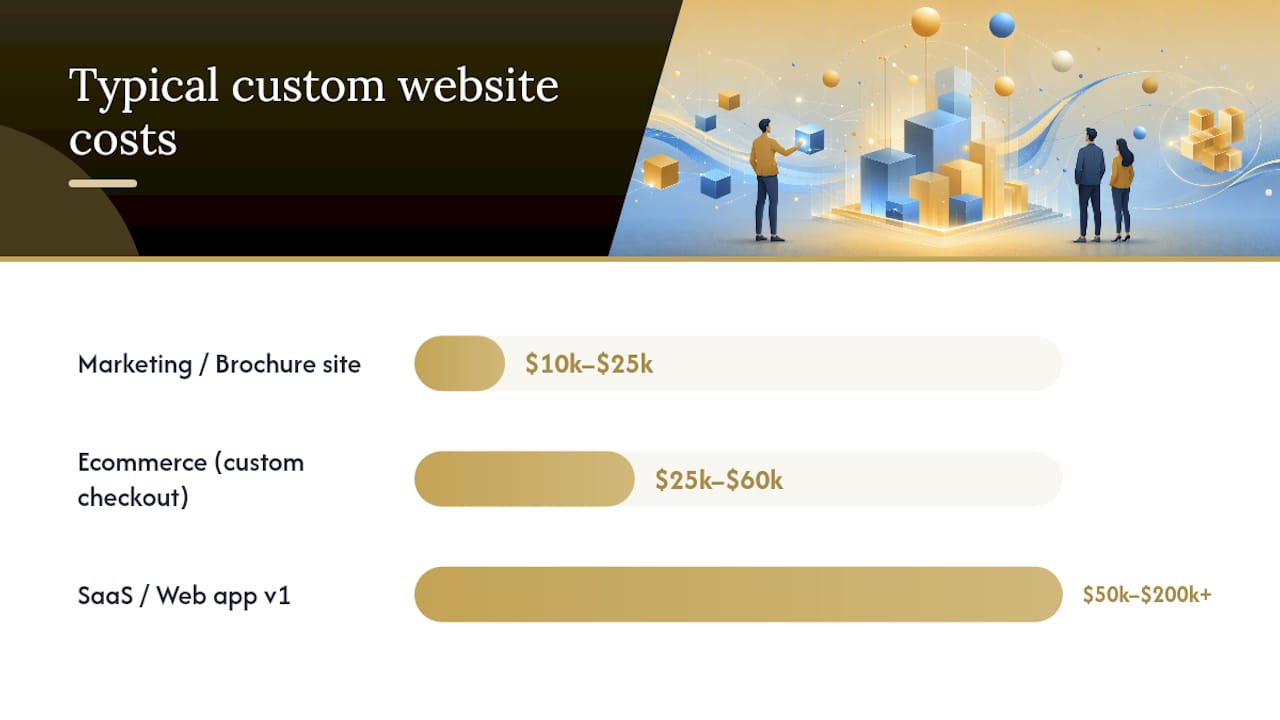
A small brochure site for a local contractor or retail shop typically covers a homepage, service pages, an about page, and a contact form, with custom design and mobile optimization built in. The primary driver pushing this toward the higher end is custom photography, video, or animation work rather than page count.
A mid-level ecommerce build with custom checkout logic costs more because product variant handling, shipping calculators, and inventory sync with a point-of-sale system all require custom backend work. A straightforward product catalog with standard checkout stays closer to the lower end; anything involving custom pricing rules or multi-location inventory pushes toward $60,000.
A SaaS or web app version 1 carries the widest range because "web app" covers everything from a simple booking tool to a multi-tenant platform with role-based permissions. User authentication, data modeling, and third-party API integrations are the line items that swing this budget the most.
Vendor location and team makeup matter more than most buyers expect going in. Neither approach is wrong. It depends on how much hand-holding you need during the build.
How Long Does a Custom Website Build Take?
Timeline tracks closely with budget, which makes sense once you know both are driven by the same underlying complexity.
- Small marketing sites — Discovery (1–2 weeks), design (2–3 weeks), development (2–4 weeks), QA and launch (1 week). Total: 6–10 weeks.
- Ecommerce builds — Discovery (2–3 weeks), design (3–4 weeks), development (6–10 weeks), QA (2–3 weeks), launch prep (1–2 weeks). Total: 3–5 months.
- Custom web apps — Discovery (3–4 weeks), design (4–6 weeks), development (10–20 weeks), QA (3–4 weeks), launch (2 weeks). Total: 4–9 months.
Parallel teams, an early scope freeze, and fast stakeholder feedback all accelerate delivery. The single biggest delay factor isn't the vendor. It's clients who take two weeks to approve a homepage mockup.
Pro Tip: If your budget or timeline is tight, ask about a phased launch. Ship the core pages first, then add secondary features post-launch instead of holding the whole site hostage to the last integration getting finished.
What Should You Ask For When Requesting Quotes?
Comparing vendor quotes gets confusing fast when each one uses a different pricing model and different assumptions. An RFP that spells out scope clearly is the single best tool you have for getting apples-to-apples numbers back.
Build your request around these steps:
- Write a one-page scope summary listing every page, feature, and integration you need.
- Specify your must-have launch date and any hard deadlines.
- Ask for a fixed price where possible, or an hourly estimate with a not-to-exceed cap.
- Request references or a portfolio link for projects similar in scope to yours.
- Ask each vendor to list assumptions their price depends on.
Once quotes come back, dig into specifics with direct questions:
- Who owns the code, design files, and content after final payment?
- What's included in post-launch support, and for how long?
- Where will the site be hosted, and who manages backups?
- What happens if a third-party API or plugin changes and breaks something?
Watch for red flags: a proposal with no QA phase listed, vague line items like "development" with no hour breakdown, or a refusal to provide client references. A vendor who can't explain their own pricing clearly probably can't explain scope changes clearly either, and that gap gets expensive later.
How Can You Lower Custom Website Cost Without Cutting Corners?
You don't have to choose between a full custom build and a generic template. Several tactics let you control cost while protecting the outcomes that actually matter to your business.
- Phase the work — Launch core pages first, add secondary features in a second release.
- Prioritize core user journeys — Build the paths that drive revenue first; polish secondary pages later.
- Reuse proven modules — Custom doesn't mean building every component from zero.
- Use managed hosting — Skip the DevOps overhead of self-managed servers.
- Limit custom integrations at launch — Add complex third-party connections in version two once revenue justifies them.
Each tactic trades something. Phasing delays feature completeness. Reusing modules limits how unique certain sections look. Neither trade-off is bad, but you should choose it knowingly rather than discover it after signing a contract.
Pro Tip: About 80% of businesses don't actually need a fully custom build. A premium template at $1,500 to $3,000 can validate your business model for 6 to 18 months before you invest in custom development, which is a smart move if you're still proving the concept works.
What Does Custom Cost Over Three Years Compared to a Template?
Upfront price tells only part of the story. A three-year view shows why custom builds sometimes cost less overall, even with a higher starting price.
Template sites carry a lower sticker price, but plugin conflicts, slower load times, and the owner's own time spent troubleshooting rarely show up in that initial number. A hand-coded site typically runs faster out of the gate and needs fewer emergency fixes, which shifts real cost away from firefighting and toward planned maintenance. Kirk-co's maintenance and support plans fold updates, security patches, and monitoring into one predictable monthly cost instead of a pile of separate subscriptions.
Pro Tip: Budget for security updates the same way you'd budget for an oil change. Skipping it doesn't save money. It just delays the bill and usually makes it bigger.
Does Your Tech Stack Change What You Pay?
Yes, though not always in the direction people assume. The programming language itself rarely swings cost as much as the ecosystem around it does. A stack with mature, well-documented frameworks and a large developer pool tends to cost less to build and maintain than a niche or bleeding-edge stack, simply because more developers can work on it and troubleshoot problems faster.

Custom-coded sites built on lean, hand-written frontend and backend code typically load faster than sites built on heavy CMS platforms loaded with plugins, and faster load times reduce the ongoing cost of performance troubleshooting. That said, a more minimal stack can mean fewer pre-built components to lean on, which sometimes raises initial development hours for common features like search or user accounts.
Database choice matters too. A relational database suits structured data like inventory or bookings; a document-based database often suits flexible content structures better. Picking the wrong one for your use case doesn't show up as extra cost immediately. It shows up eighteen months later when a simple feature request turns into a database migration project.
Licensing is the other stack-related cost people underestimate. Some frameworks and libraries are free and open-source; others carry per-seat or per-server licensing fees that scale with your traffic or team size. Ask any vendor proposing a specific stack to disclose licensing costs upfront, not as a surprise line item once the contract is signed. A stack chosen for the developer's convenience rather than your business needs is a cost decision disguised as a technical one.
What Do Privacy and Accessibility Compliance Cost?
Legal and compliance work is easy to skip during budgeting and expensive to retrofit later. Three areas matter for most small business sites: privacy policy documentation, data privacy regulation compliance, and accessibility.
A basic privacy policy generated from a template costs little to nothing, but a policy that actually reflects what your site collects and how it's used typically requires either legal review or a specialized service, often a few hundred dollars for a straightforward small-business site.
Data privacy regulations that apply based on where your visitors live can require cookie consent banners, data deletion request handling, and clear disclosure of third-party tracking tools. Building this in during development costs far less than adding it after launch, since consent management often touches every page and every analytics integration on the site.
Accessibility work under the Americans with Disabilities Act (ADA) matters for any business serving the public, and courts have increasingly treated websites as covered public accommodations. Building accessible markup, proper color contrast, and keyboard navigation into the initial design costs a modest percentage more than skipping it. Retrofitting an inaccessible site after a demand letter arrives costs dramatically more, both in developer hours and in legal exposure. This is one area where "we'll add it later" is consistently the more expensive choice.
When Is Custom Actually Worth the Investment?
Custom development earns its price when your business runs on logic no template can replicate: a booking system with unusual scheduling rules, a marketplace connecting buyers and sellers, or a performance and security profile that generic platforms can't hit. If your business model depends on speed, a unique conversion flow, or handling data no plugin was built to manage, custom isn't a luxury. It's the only approach that actually works.
A premium template is the smarter call when your needs are simple: a brochure site, a basic service listing, or a business still validating demand before committing real capital. There's no shame in starting there.
Local businesses we've worked with have seen concrete gains in load speed and lead volume after moving from template platforms to hand-coded builds, and that pattern shows up consistently enough in our portfolio that we no longer treat it as a coincidence.
Ready for a Custom Site? Here's What Kirk-co Offers
If you've read this far, you probably already know whether your business needs custom development or a well-chosen template. If it's custom, here's what working with Kirk-co looks like in practice.
Kirk-co hand-codes every website from scratch for local businesses across Indiana, including contractors, retailers, nonprofits, and home service providers. No page builders, no bloated plugin stacks slowing down your load times. That approach is exactly why our clients typically see faster pages and stronger local search performance than template-based competitors in their market.
Custom projects with Kirk-co typically start in the range you'd expect from the small-to-mid custom bands covered above, and that starting price includes discovery, hand-coded design and development, local SEO setup, and a full launch checklist. Every build also comes with the option to roll into a monthly maintenance plan so your site keeps evolving instead of going stale six months after launch.
If you're ready to see what a hand-coded site could do for your business, start with our custom website development page and request a project quote.
Sources
The cost ranges in this guide come from calibrated project quote data and published 2026 industry pricing guides, cross-checked for consistency across freelancer, small-agency, and enterprise bands.
- Custom Website Cost 2026 — From $5K to $100K+
- How Much Does A Website Cost? (2026 Guide) – Forbes Advisor
- How Much Does It Cost To Build a Website in 2026? - Upwork
- Tech
Ranges throughout this guide reflect an hours times rate methodology cross-referenced against real vendor quotes, not theoretical estimates.