
Six categories decide whether a website project goes smoothly or turns into a mess: experience and fit, scope and pricing, timeline and process, platform and ownership, technical performance including SEO and accessibility, and post-launch support. Ask about all six before you hire anyone. Below is a ranked top-10 checklist you can run on your very first call, followed by the detail behind each category.
TL;DR:
- Ensure the designer provides specific industry-relevant project examples and can explain design choices related to typography, whitespace, and responsiveness.
- Obtain a detailed, written quote that clearly itemizes costs for design, development, hosting, and ongoing fees, including how change orders are handled.
- Confirm the ownership of the domain, hosting, and code, ensuring these are transferred to your name before signing any contract.
- Establish a milestone-based timeline with clear responsibilities and staging site access, and ensure the designer has a process for handling delays and revisions.
- Verify the site's technical performance, SEO, and accessibility standards, including platform choices, load-time targets, and WCAG level testing.
Table of Contents
- Top 10 Questions to Ask a Web Designer on the First Call
- Checking Experience and Fit Before You Commit
- Getting a Written Quote That Covers the Full Annual Cost
- Confirming the Timeline and Project Process
- Verifying Technical Quality, SEO, and Accessibility
- Locking Down Ownership, Access, and Deliverables
- Setting Clear Expectations on Revisions and Communication
- Confirming Post-Launch Support and Security
- Spotting Red Flags Versus Strong Answers
- Running Your 15-Minute Discovery Call
- What I Never Skip When Hiring a Designer
- Sources
Top 10 Questions to Ask a Web Designer on the First Call
You don't need an hour to figure out if a designer is right for your business. Ten focused questions, asked in order, will tell you almost everything you need to know.
- "Can you show me two or three projects for businesses like mine?" A green flag sounds specific: names, industries, and results. A red flag is a generic portfolio slideshow with no context.
- "What's included in this quote, line by line?" Good answers break down design, development, copy, SEO setup, and integrations. Vague lump-sum pricing is a warning sign.
- "Who owns the domain, hosting, and code once we're done?" You want to hear "you do, from day one." Anything else needs follow-up questions.
- "What's the realistic timeline, and what do you need from me at each stage?" Strong answers name milestones. Weak ones just say "a few weeks."
- "Who on your team will actually build my site?" Ask this directly, especially if the portfolio work was done by someone else at the firm.
- "How many rounds of revisions are included?" A clear number is good. "As many as you need" often means the opposite once you're mid-project.
- "What are the recurring costs after launch?" Hosting, plugins, maintenance. Get real numbers, not "we'll figure it out later."
- "What's your process for site speed and mobile performance?" Listen for specifics like load-time targets, not just "it'll be fast."
- "Do you test for accessibility, and to what standard?" A confident designer references WCAG levels. Silence here is a problem.
- "Can I contact two recent clients?" Real designers say yes without hesitation.
Checking Experience and Fit Before You Commit
A polished portfolio tells you a designer can design. It doesn't tell you whether they can solve your specific problem, which is why you need to push past the pretty screenshots.
Ask for work in your industry or something close to it. A contractor site and a boutique retail site solve different problems, so a designer who's only built e-commerce stores may struggle with a service-area business that needs strong local SEO instead. When you do see relevant examples, ask what changed. Toptal's guide to vetting design talent points out that stronger candidates can speak fluently about typography, whitespace, and responsive design decisions, not just show finished screens. Visual polish alone doesn't guarantee results either. Research on first impressions shows design quality directly affects how long visitors stay and whether they convert, so ask for a before-and-after number tied to a real project, like a load-time improvement or a jump in form submissions.
References matter more than most people treat them. Two recent clients, contacted directly, will tell you things a portfolio never will.
- Ask the reference how the designer handled a change of mind mid-project.
- Ask if the site launched on schedule, and if not, why.
- Ask whether support after launch was easy to reach.
- Confirm the person you'd be working with is the same person who did the showcased work, not a junior brought in after the sale.
Pro Tip: Ask a reference to screen-share their site's analytics dashboard for thirty seconds. A real client with a real result will do this without blinking.
Getting a Written Quote That Covers the Full Annual Cost
The number on the first email is rarely the number you'll actually pay. What matters is what's underneath it.
Insist on a written, itemized quote before you sign anything. It should separate design, development, copywriting, photography or stock imagery, SEO setup, and any third-party integrations like booking tools or payment processors. A one-line total with no breakdown makes it nearly impossible to know what you're paying for, or to negotiate if your budget is tight.
Beyond the build itself, ask what you'll owe every month or year after launch:
- Hosting fees, and whether they're bundled or billed separately.
- Premium plugin or theme licenses that renew annually.
- Domain registration and SSL renewal costs.
- Email hosting if it's tied to the website package.
- Ongoing maintenance or care plan fees.
Also ask how change orders work. Every project drifts a little from the original plan, and a designer who can't explain how extras get priced upfront will surprise you later. Ask for two or three examples of common add-ons past clients requested, like an extra landing page or a new photo gallery, and what those cost. That single question usually reveals whether pricing is transparent or made up on the spot.
Confirming the Timeline and Project Process
A vague timeline is one of the fastest ways a website project turns into a six-month ordeal. Nail down the milestones before work starts.
- Ask for a milestone-based schedule, not just a launch date. Discovery, design mockups, development, content upload, testing, and launch should each have a date attached.
- Ask what you're responsible for delivering at each milestone. Photos, copy, and logo files are common client-side bottlenecks, and a designer worth hiring will tell you exactly when they need those from you.
- Confirm staging site access. You should be able to view the in-progress site on a private link before it goes live, not just see finished screenshots.
- Ask if the project uses version control, like Git, and whether you'll have visibility into it. This matters if you ever need to bring in a different developer down the line.
- Ask what the typical turnaround is for revision requests. A day or two is normal; two weeks per round is not.
- Ask how delays get handled. Projects slip. What matters is whether the designer has a process for communicating that instead of going quiet.
Verifying Technical Quality, SEO, and Accessibility
This is where a lot of business owners stay quiet because the terms feel technical. You don't need to be an engineer to ask sharp questions here.
Start with the platform. Ask which content management system or framework they build on, and why they chose it for your project. A hand-coded site tends to load faster and stay more flexible long-term, while a template-based builder can be quicker to launch but slower and harder to customize later. Either can be the right call depending on your budget and goals, but the designer should be able to explain the trade-off, not just default to whatever they always use.
Ask about performance targets specifically. Faster page speed correlates with both better search rankings and higher conversion rates, so a designer with a real process will mention image compression, caching, or a specific load-time goal rather than a vague promise of "it'll be fast."
- What SEO tasks are included: redirects from an old site, meta descriptions, schema markup?
- Which analytics platform gets installed, and do you get admin access to it?
- What accessibility level do you test against, and with what tools?
- How is mobile responsiveness checked across different screen sizes?
Federal projects and many public-facing businesses are expected to meet Section 508 accessibility standards, and even when that law doesn't apply directly, WCAG guidance is the practical benchmark most designers should be testing against. If a designer can't name a standard, that's worth noting.
Locking Down Ownership, Access, and Deliverables
A shocking number of business owners discover, months after launch, that they don't actually own their own website. The domain sits in the designer's account. The hosting is billed to the agency. If that relationship ends badly, you're stuck.
Settle this before the contract is signed:
- The domain and hosting accounts should be registered in your name, or transferred to your account, not held under the designer's business.
- You should get admin-level access to the CMS, plus login credentials for any paid plugins or third-party tools used on the site.
- Version control access, if the project uses Git, should include you or your future developer.
- At final handoff, ask for a documented package: admin logins, exportable content, a basic style guide, and repository details if applicable.
Agency guidance on vetting web design partners consistently flags unclear ownership and missing documentation as the top cause of post-launch disputes. Ask this question early, not after you've already paid a deposit.
Setting Clear Expectations on Revisions and Communication
Vague revision terms cause more friction than almost anything else in a web project. Get specific numbers before you start.
- Ask exactly how many revision rounds are included in the quoted price, and what counts as a revision versus a brand-new request that costs extra.
- Ask who your main point of contact will be, and how quickly they typically respond to emails or messages.
- Ask whether any part of the work, like development or copywriting, gets subcontracted out, and how those subcontractors are vetted.
Larger firms often split design, development, and SEO across separate specialists, which isn't a problem by itself. It becomes a problem when nobody owns a deliverable end-to-end and requests bounce between people with no clear answer.
Confirming Post-Launch Support and Security
A website isn't finished the day it goes live. Ask what happens the week after, and the year after.
- What maintenance packages are offered, and do they include software updates, backups, and security scans?
- What's the response time if a form breaks or the site goes down entirely? Get a real number, not "we'll get to it."
- Who renews the SSL certificate, and who's watching the expiration date?
- How will you be notified if something goes wrong: email, phone, a support ticket system?
SSL certificates that lapse without warning can knock a site offline or trigger browser security warnings that scare visitors away, so this isn't a minor detail to skip past. A designer with a real maintenance process will have a clear answer ready, not a shrug.
Spotting Red Flags Versus Strong Answers
Some answers should stop you cold. Others should make you feel confident enough to sign.
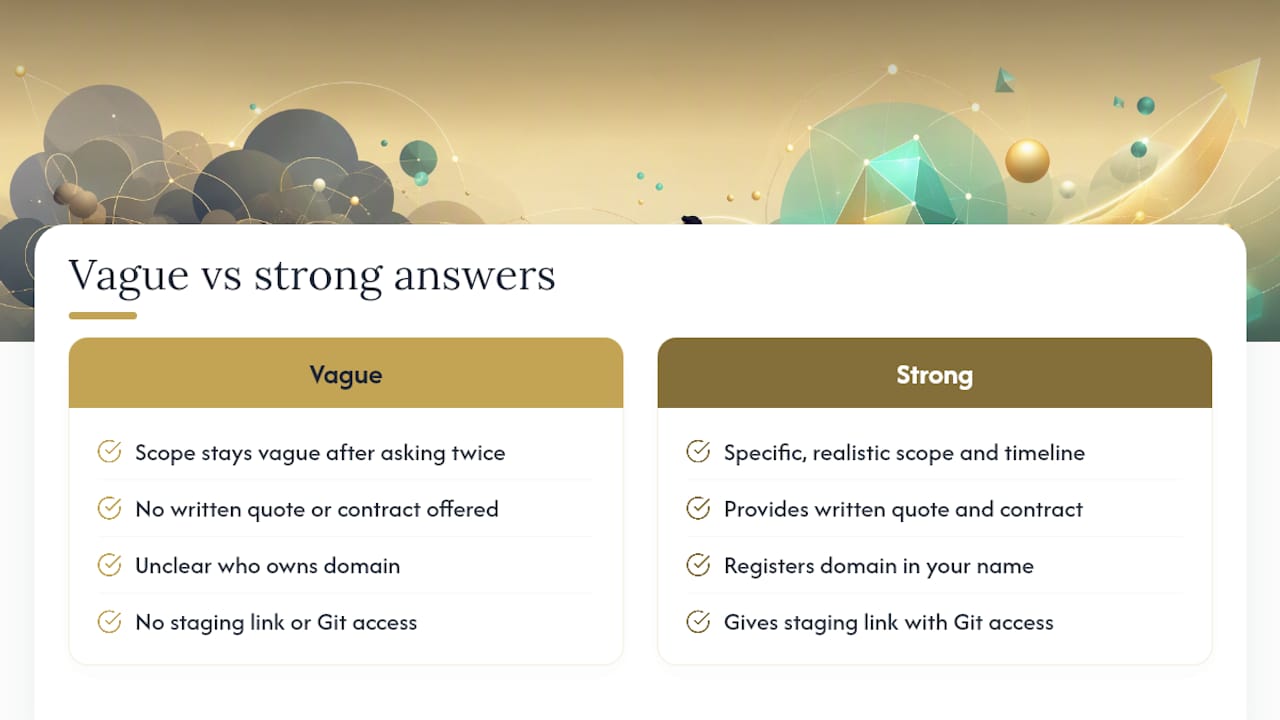
Red flags worth walking away from: a scope that stays vague even after you ask twice, no written quote or contract offered, unclear answers about who owns the domain, and a timeline that sounds too fast to be realistic for the work involved.
Strong answers sound specific and unhurried. "We register the domain in your name from day one. You'll get a staging link with Git access, and two weeks of free support after launch" is the kind of two-sentence answer that tells you this designer has done this many times before.
Pro Tip: If a reference hesitates to share even one number, like a load-time improvement or a lead increase, ask for a screenshot of the analytics instead. A designer confident in their results won't mind.
Running Your 15-Minute Discovery Call
You don't need a formal meeting to get real answers. A short call, structured well, covers almost everything.
- Open with your project in one sentence. What kind of business, what you need the site to do.
- Ask to see two relevant portfolio pieces and what results came from them.
- Ask what's included in a typical quote for a project your size.
- Ask for a realistic timeline and what you'd need to provide along the way.
- Ask directly who owns the domain and code after launch.
- Close by asking for a rough budget range and what the next step looks like if you want to move forward.
After the call, request three things in writing before you commit: an itemized scope document, contact information for two references, and confirmation of staging access. If those three items show up without hesitation, you're likely talking to someone who runs an organized shop.
What I Never Skip When Hiring a Designer
Ownership is where I stop the conversation if the answer is unclear. If a designer can't say plainly that the domain, hosting, and code belong to you the moment the invoice is paid, I don't move forward, no matter how good the portfolio looks. That single point has ended more business relationships badly than pricing disputes ever will.
The other non-negotiable is getting the scope in writing before any money changes hands. Verbal promises about what's "included" evaporate the moment a project gets busy. A one-page document listing deliverables costs the designer ten minutes to write and saves you weeks of arguing later.
Everything else on this list matters, but those two items are where good projects and bad ones actually split apart.
— Elijah
If you'd rather skip the vetting process and work with a team that already answers these questions the right way, Kirk & Co Software builds hand-coded, conversion-focused websites for small businesses across Indiana, including contractors, retailers, and nonprofits, and every project ships with clear ownership, a written scope, and support built in from the start. Take a look at recent work in the Kirk & Co portfolio before your next discovery call, and use it as the benchmark for what a real answer to these questions should sound like.
Sources
- Section 508 — laws and policies
- Web designer interview questions — Toptal
- Questions to ask before hiring a web design agency — Outerwave Media