
A professional website redesign for a small- to mid-sized U.S. business typically costs between $5,000 and $65,000 in 2026, with most projects landing in this band depending on scope and feature set. Industry data places the median full web project cost near $36,500. Most SMBs, however, spend well under that when they scope carefully.
The single most useful next step is not to call agencies yet. Run a short scope checklist first: count your pages, list every custom feature (booking, portals, e-commerce), and note your current platform. That 15-minute exercise turns a broad budget range into a focused conversation in the $12,000–$20,000 band if you have a typical SMB scope.
The biggest cost drivers at a glance:
- Content migration — moving 50 pages can take 20–40 hours of labor, plus manual QA
- Custom features and integrations — CRM connections, booking engines, and member portals each add a fixed scope block
- Page count — more pages mean more design, build, and QA hours
- E-commerce complexity — SKU count, checkout customization, and payment integrations scale cost quickly
- Platform choice — replatforming to a new CMS costs more than a same-platform refresh
Table of Contents
- What does a website redesign cost by project tier in 2026?
- What line items actually move the needle on your redesign price?
- What deliverables should you expect at each price tier?
- How does e-commerce change your redesign budget?
- Template refresh or custom hand-coded build — which is right for you?
- How do agencies and freelancers price redesign work?
- How long does a website redesign actually take?
- How can you lower redesign costs without hurting results?
- How to spot padding in estimates and a real Kirk-co budget example
- Payment schedules, ongoing costs, and U.S. tax considerations
- How to justify a redesign to leadership with KPIs and a simple ROI model
- Questions to ask agencies before you sign anything
- Key Takeaways
- The real cost conversation nobody is having
- Ready to get a real, itemized quote for your redesign?
- Useful sources
What does a website redesign cost by project tier in 2026?
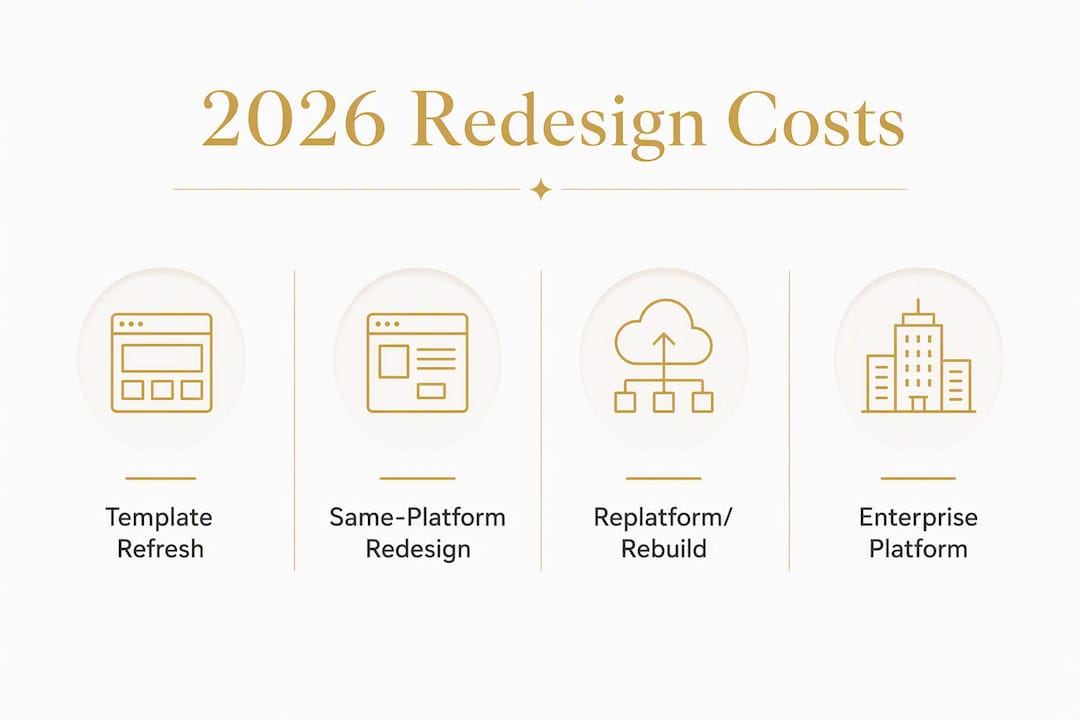
Published agency ranges often reflect higher budgets for larger projects. Those numbers are real for large agencies with large overhead, but they do not describe most SMB projects. Here is an illustrative view of where many redesigns fall, showing tiers from entry-level DIY to enterprise projects, each including typical services and timelines.
Stat to know: Clutch buyer data indicate a median full web project cost suggestive of a mid-range budget, with many SMBs spending less reflecting smaller scopes.
The overlap between tiers is intentional. A 20-page site with a custom booking system and local SEO migration can easily push a "small agency" project to $28,000. The same site without those features might land at $9,000. Scope, not tier label, is what drives the final number.
One factor many buyers miss: redesigns typically cost 15–40% more than a fresh build of the same size. Content migration, redirect mapping, and legacy system cleanup add hours that a greenfield project simply does not have.
What line items actually move the needle on your redesign price?
Understanding cost drivers lets you make deliberate trade-offs before you ever talk to a vendor. Here are the items that consistently push budgets up or down:
- Discovery and strategy — typically 15–20% of total project cost; covers stakeholder interviews, analytics review, competitor benchmarking, and a defined sitemap. Skipping it saves money upfront and usually costs more in change orders later.
- Page count and templating — each unique page template adds design and development hours. A 30-page site built on 4 templates costs far less than 30 unique layouts.
- Custom features and integrations — CRM connections (Salesforce, HubSpot), booking engines, client portals, and API integrations each add a discrete scope block. Budget $2,000–$8,000 per major integration depending on complexity.
- E-commerce functionality — covered in detail in the next section, but even a basic WooCommerce or Shopify setup adds $3,000–$10,000 over a standard brochure site.
- Content creation and migration — writing new copy, sourcing photography, and migrating existing content are frequently underestimated. Moving 50 pages takes 20–40 hours, and automated migration still requires manual QA on roughly 30% of pages.
- Accessibility and QA — WCAG 2.1 AA compliance testing, cross-browser QA, and mobile testing add 10–15% to development time on most projects.
- Performance engineering — Core Web Vitals optimization, image compression pipelines, and caching configuration matter for SEO and conversions; hand-coded sites handle this at the build level, while theme-based builds often require plugins and ongoing tuning.
- Post-launch support — a 30-day stabilization period, bug fixes, and a training session are standard on well-scoped projects; confirm whether these are included or billed separately.
Pro Tip: Before requesting quotes, audit your existing content. List every page, note which pages will carry over, which need rewriting, and which can be retired. Agencies price content migration by the hour, so a clean audit sheet can save you $1,500–$4,000 in scoping ambiguity.
What deliverables should you expect at each price tier?
Price alone does not tell you whether a proposal covers the work you actually need. Here is what each tier typically delivers and what it often leaves out.
Template refresh ($2,000–$8,000)
You get a new visual skin on your existing CMS, updated typography and colors, and a mobile-responsive layout. Discovery is usually a single kickoff call. Wireframes are minimal or skipped. SEO redirects may not be included, and content migration is often billed separately. Good for businesses whose structure and content are sound but whose design feels dated.
Same-platform redesign ($8,000–$30,000)
This tier covers a proper discovery phase, information architecture (IA) work, wireframes for key page types, custom visual design, development, QA, basic on-page SEO, and a launch checklist. Discovery typically accounts for 15–20% of total budget, visual design 25–35%, and project management 5–10%. Training and a 30-day support window are usually included at the higher end of this range.

Replatform or rebuild ($35,000–$65,000)
Full discovery, UX research, detailed wireframes, custom design system, development on a new CMS or custom stack, third-party integrations, SEO migration with 301 redirect mapping, accessibility audit, performance testing, and a formal handoff with documentation. Content writing and photography are almost always add-ons at this tier.
Enterprise platform work ($100,000+)
Everything above, plus multi-stakeholder governance, custom API development, advanced analytics instrumentation, load testing, and phased rollout planning. Ongoing A/B testing programs and personalization engines are typically scoped as separate retainers.
A milestone map for a mid-market project:
- Discovery (weeks 1–2): stakeholder interviews, analytics audit, sitemap, brief
- IA and wireframes (weeks 3–4): page templates, user flows, content inventory
- Visual design (weeks 5–7): design system, key page comps, client review cycles
- Development (weeks 8–13): CMS build, integrations, responsive implementation
- QA and testing (weeks 14–15): cross-browser, mobile, accessibility, performance
- Launch (week 16): DNS cutover, redirect deployment, analytics verification
- 30-day stabilization: bug fixes, training, minor copy updates
How does e-commerce change your redesign budget?
An e-commerce redesign is not simply a brochure site with a shopping cart bolted on. The variables that drive cost are different, and they scale quickly.
E-commerce-specific cost drivers:
- Product catalog size — a 50-SKU store and a 5,000-SKU store require fundamentally different filtering, search, and database architecture
- Checkout customization — multi-step checkout flows, upsell logic, and subscription billing add significant development hours
- Payment gateway integrations — Stripe and PayPal are standard; adding Authorize.net, Affirm, or buy-now-pay-later options each adds scope
- Shipping and rate integrations — real-time carrier rates (UPS, FedEx, USPS), dimensional weight logic, and multi-warehouse routing are non-trivial builds
- POS sync — connecting an online store to Square, Clover, or a custom POS system is one of the most time-intensive integrations
- Promotions and discount engines — tiered pricing, coupon stacks, and loyalty programs require custom logic beyond what most themes provide out of the box
Example e-commerce budgets:
A small store (under 100 SKUs, Shopify or WooCommerce theme, standard checkout, two payment gateways) typically runs $8,000–$18,000. The cost driver here is usually product photography and content setup, not development.

A mid-size store (500–2,000 SKUs, custom Shopify or WordPress build, filtered search, shipping integrations, POS sync) lands in the $25,000–$55,000 range. Custom search and POS sync alone can add $8,000–$15,000.
An enterprise store (5,000+ SKUs, custom platform or headless commerce, multi-currency, ERP integration, advanced promotions) starts at $80,000 and scales with complexity.
Replatforming from one e-commerce system to another adds a data migration layer on top of the redesign itself. Product data, customer records, and order history all need to transfer cleanly, and that work is almost always billed separately.
Template refresh or custom hand-coded build — which is right for you?
This is the decision that most directly shapes your budget, your site's long-term performance, and how much ongoing maintenance you will need.
Template-driven builds (WordPress themes, Shopify themes, Webflow templates)
Pros:
- Lower upfront cost, typically 30–60% less than a custom build for the same page count
- Faster to launch, often 2–6 weeks for a straightforward refresh
- Large ecosystems of plugins and integrations available out of the box
- Easier for non-technical staff to update content
Cons:
- Template bloat: most themes load CSS, JavaScript, and features you never use, which slows page speed and hurts Core Web Vitals scores
- Limited differentiation: your site may look similar to thousands of others using the same theme
- Customization debt: heavy theme modifications become harder to maintain with each plugin update
- SEO ceiling: page speed and structured data control are constrained by the theme's architecture
Custom hand-coded builds
Pros:
- Every line of code serves a purpose, which means faster load times and cleaner Core Web Vitals scores
- Full design flexibility with no template constraints
- Easier to implement precise local SEO signals (schema markup, structured data) at the code level
- No plugin dependency chains that break on updates
Cons:
- Higher upfront cost
- Longer build time
- Content updates may require developer involvement unless a headless CMS is paired with the build
When does custom code justify the cost? When your business competes on local search visibility, when conversion rate is a primary KPI, or when you need integrations that no off-the-shelf plugin handles cleanly. For a contractor, home service business, or local retailer where a single additional lead per week pays for the site in a year, the performance gap between a bloated theme and a clean hand-coded build is measurable in dollars.
Platforms like WordPress, Shopify, and Webflow all support both approaches to varying degrees. WordPress and Webflow can be built on templates or coded from scratch. Shopify's theme system is more constrained, though headless Shopify builds remove that ceiling at a higher cost.
How do agencies and freelancers price redesign work?
Knowing the pricing model behind a proposal helps you compare quotes that look very different on paper.
Common pricing models:
- Fixed-fee per milestone — the most common model for SMB projects; you know the total cost upfront, and payment is tied to deliverable completion. Best when scope is well-defined before the contract is signed.
- Time and materials (T&M) — you pay for actual hours worked at agreed rates. Flexible for projects where scope may evolve, but requires active oversight to avoid budget drift.
- Retainer — a monthly fee for ongoing design, development, and support work. Common for post-launch improvements and maintenance.
- Value-based pricing — the fee is tied to projected business outcomes (conversion lift, revenue increase) rather than hours. Less common but increasingly used by conversion-focused agencies.
Typical U.S. role-based rates (2026):
| Role | Hourly Rate Range | Notes |
|---|---|---|
| UX / UI Designer | $75/hr | Higher end for senior strategists |
| Front-end Developer | $80–$100/hr | Custom/hand-coded work at the top of range |
| Back-end / Full-stack Developer | $100–$200/hr | API and integration work drives the higher end |
| Project Manager | $65–$120/hr | Often bundled into agency overhead |
| SEO Specialist | $75/hr | Migration and technical SEO at the higher end |
| Copywriter | $60–$120/hr | Varies widely by industry and experience |
A 200-hour mid-market project at a blended agency rate of $125/hr produces a $25,000 estimate before discovery, QA, and project management are added. That math is a useful sanity check when reviewing proposals.
Fixed bid vs. T&M: Choose fixed-bid when you have a detailed brief and want cost certainty. Choose T&M when the scope is genuinely exploratory or when you expect the brief to evolve. In either case, require a task-level hour breakdown in the proposal so you can see exactly what you are paying for.
How long does a website redesign actually take?
Timeline expectations vary as much as budgets do. Here are realistic ranges by project type:
- Quick template refresh: 2–4 weeks from kickoff to launch
- Same-platform redesign: 6–10 weeks for a well-scoped SMB project
- E-commerce rebuild or replatform: 10–16+ weeks, depending on catalog size and integrations
- Enterprise platform work: 3–9+ months, with phased rollouts common
For a mid-market project, a reasonable milestone schedule looks like this: discovery and IA in weeks 1–2, wireframes and design in weeks 3–7, development in weeks 8–13, QA and testing in weeks 14–15, and launch in week 16 with a 30-day stabilization window following.
The three most common timeline killers:
- Content delays — clients underestimate how long it takes to gather, write, and approve copy and images. Build a content deadline into the contract, not just a launch date.
- Third-party integrations — API documentation is often incomplete, and sandbox environments behave differently from production. Add a two-week buffer for any integration you have not built before.
- Stakeholder review cycles — every additional approver adds days. Define who has final sign-off authority before the project starts.
Running a cost and scope calculator before your first agency call helps align your internal timeline expectations with what the scope actually requires.
How can you lower redesign costs without hurting results?
Cutting budget does not have to mean cutting quality. These tactics reduce upfront spend while protecting the outcomes that matter.
- Phase the rollout — launch a core site (homepage, key service pages, contact, local SEO foundation) in phase 1, then add features in phase 2 after you have real traffic data to guide decisions.
- Prioritize high-impact pages — your homepage, primary service or product pages, and contact page drive the majority of conversions. Invest design and development hours there first.
- Reuse components — a well-built design system means a button, card, or section built once can be reused across dozens of pages without additional cost.
- Accept templates for secondary pages — blog archives, team bios, and FAQ pages rarely need custom layouts. A clean template saves hours without affecting conversion.
- Bundle content tasks — provide finalized copy and approved images before development starts. Agencies charge for content rounds; reducing those rounds directly reduces cost.
- Use AI-assisted tooling for initial layouts — combining AI or template tooling with a developer for migration, SEO, and custom integrations can reduce costs meaningfully for low-to-mid complexity sites while preserving a modern look.
A two-phase example:
Phase 1 (launch in 8 weeks): Core pages, mobile-optimized design, local SEO setup, 301 redirects, Google Analytics 4 configuration, contact form. Budget: $8,000–$15,000.
Phase 2 (3–6 months post-launch): Blog, case studies, booking integration, conversion rate optimization testing. Budget: $5,000–$12,000.
Total spend is similar to a single-phase project, but phase 2 decisions are informed by real user data rather than assumptions.
Pro Tip: Never cut 301 redirects from scope to save money. Every URL that returns a 404 after launch is a lost backlink and a lost ranking. Map redirects before launch, not after. Similarly, preserve your highest-traffic landing pages in phase 1 even if they are not conversion priorities.
How to spot padding in estimates and a real Kirk-co budget example
A proposal is not a price; it is a negotiation document. Here is how to read one critically.
Checklist to spot padding:
- Ask for hours per task, not just a lump-sum phase total. "Design: $8,000" tells you nothing. "Homepage design: 12 hours at $120/hr" is verifiable.
- Request role-level rates for every line item. A project that lists a $175/hr developer rate for content entry is padding.
- Check for duplicate line items — "QA" listed under both development and a separate testing phase is a common double-count.
- Compare discovery scope to scheduled hours — a 2-hour kickoff call billed as a $3,000 discovery phase is a red flag.
- Require deliverables tied to milestones — every payment should release only when a defined deliverable is accepted.
- Verify that quotes outside the typical $35k–$65k mid-market range carry a granular, role-level breakdown to justify the outlier.
Kirk-co client budget example (anonymized):
A local construction company came to Kirk-co with a slow, template-based site that was losing leads to faster competitors in local search. The initial agency quote they received elsewhere was $42,000. After a scoping session with Kirk-co, the project was structured as follows:
| Phase | Deliverable | Budget |
|---|---|---|
| Discovery | Stakeholder brief, analytics audit, sitemap | — |
| Design | Custom UI, mobile layouts, design system | — |
| Development | Hand-coded build, local SEO, schema markup | — |
| QA and testing | Cross-browser, mobile, Core Web Vitals | — |
| SEO migration | 301 redirects, meta migration, GSC setup | — |
| Launch and training | DNS, handoff, 30-day support | $500 |
Trimming non-essential extras (a custom blog module and a team gallery slider) reduced the original scope by roughly 25% without affecting the pages that drive leads. The site launched in 9 weeks. For small businesses in Indiana, this kind of itemized, milestone-based approach is exactly what separates a fair quote from an inflated one.
Contract terms to require:
- Acceptance criteria for each deliverable before the next milestone payment releases
- A written change-order process with a defined hourly rate for out-of-scope work
- Clear IP ownership: you own the final code, design files, and content on delivery
- A warranty period (typically 30–60 days) covering bug fixes at no additional charge
- Termination conditions that specify what deliverables and refunds apply if the project ends early
Payment schedules, ongoing costs, and U.S. tax considerations
Typical payment schedule:
Most agencies structure payments as a deposit (20–40% at contract signing), a mid-project milestone payment (30–40% at design approval or development kickoff), and a final payment (20–30%) at launch. A $15,000 project might look like: $4,500 deposit, $6,000 at design approval, $4,500 at launch.
Ongoing costs to budget after launch:
- Hosting: $20–$200/month depending on server type and traffic
- Domain registration: $10–$20/year
- SSL certificate: often included with hosting, or $0–$100/year separately
- Maintenance and security: $100–$500/month for a managed plan covering updates, backups, and monitoring; Kirk-co's website maintenance plans bundle this with ongoing support
- Content retainer: $500–$2,000/month if you need regular blog posts, landing pages, or copy updates
Annual running costs typically land at 15–30% of the initial build cost, and over three years, total cost of ownership often approaches roughly twice the original project spend. Build that into your budget model before you approve the initial quote.
U.S. tax treatment: Website development costs may be capitalized as an intangible asset and amortized over time, or expensed in the year incurred, depending on how the IRS classifies the work and your business structure. This is general information, not tax advice. Confirm the correct treatment with a CPA before filing, particularly for projects that include both new development and ongoing maintenance.
How to justify a redesign to leadership with KPIs and a simple ROI model
The business case for a redesign is not "our site looks old." It is a revenue argument.
Core KPIs to track:
- Conversion rate (leads or purchases per visitor) — even a 0.5% lift on 5,000 monthly visitors is 25 additional leads per month
- Organic traffic — a properly executed SEO migration should maintain or grow traffic; a poorly executed one can drop it 30–50%
- Page load time — Google's research links each additional second of load time to measurable drops in conversion; Core Web Vitals scores are a proxy metric
- Lead volume and quality — track form submissions, calls, and chat initiations separately from traffic
- Average order value (for e-commerce) — checkout redesigns and upsell logic directly affect this number
A compact ROI example:
Suppose your site currently converts 1.5% of 3,000 monthly visitors into leads, producing 45 leads per month. A redesign improves that to 2.5%, producing 75 leads. At a $200 average lead value, that is $6,000 in additional monthly revenue. A $15,000 redesign pays back in 2.5 months. Present that math to leadership with conservative assumptions (1.8% conversion, not 2.5%) and the case becomes hard to argue against.
For stakeholders who are risk-averse, propose a phased spend: approve phase 1 at a fixed budget, measure results for 90 days, and use the data to justify phase 2. A conversion-focused build with clear tracking in place makes that 90-day review straightforward.
Questions to ask agencies before you sign anything
Use this checklist when evaluating proposals. Every question has a purpose.
- Provide an itemized task-hour breakdown — ask for hours per task and the role assigned to each. This is the single most effective way to compare proposals.
- Which CMS are you recommending and why? — the answer should reference your content team's technical comfort, your integration needs, and performance goals. If the answer is "we always use WordPress" or "we only do Webflow," ask why that fits your specific project.
- How do you handle SEO migration? — require a written plan covering 301 redirects, meta data transfer, XML sitemap submission, and Google Search Console verification. No plan means no SEO safety net.
- Which third-party integrations are in scope? — list every tool you use (CRM, booking, email, POS) and confirm each is explicitly included or excluded in writing.
- What is your change-order rate and process? — you need to know the hourly rate for out-of-scope work before you sign, not after.
- What does your support SLA look like post-launch? — ask for response time commitments and clarify whether the 30-day stabilization period is included or billed separately.
- Who owns the final code and design files? — the answer should be you, unconditionally, upon final payment.
- Can you share three recent client references in a similar industry? — a confident agency will provide them without hesitation.
Must-have contract terms:
- Deliverable-based milestone payments with written acceptance criteria
- IP ownership transferred to you on final payment
- A defined change-order process with a pre-agreed hourly rate
- A 30–60 day warranty for bug fixes at no charge
- Termination clause specifying deliverables and refund amounts at each stage
Scoring proposals: Build a simple matrix with five columns: total cost, scope completeness (does it cover all your requirements?), timeline, risk factors (new vendor, tight timeline, unclear integrations), and references. Score each proposal 1–5 on each dimension. The lowest-cost proposal rarely wins on total score, and that exercise makes the decision defensible to a board or ownership group.
Key Takeaways
Most SMB website redesigns in the U.S. fall between $5,000 and $65,000 in 2026, with the median full project near $36,500; scope, content migration, and custom features drive the final number more than any other factor.
| Point | Details |
|---|---|
| Budget range for most SMBs | Most projects land between $5,000 and $65,000; the median full project sits near $36,500 based on Clutch buyer data. |
| Redesigns cost more than new builds | Expect 15–40% more than a comparable new build due to content migration, redirect mapping, and legacy cleanup. |
| Content migration is the hidden cost | Moving 50 pages takes 20–40 hours; always audit existing content before requesting quotes. |
| Ongoing costs add up | Annual running costs typically reach 15–30% of the initial build; three-year TCO often approaches twice the original spend. |
| Kirk-co for Indiana SMBs | Kirk-co delivers hand-coded, itemized-budget redesigns for local businesses in Indiana, with milestone-based payments and no template bloat. |
The real cost conversation nobody is having
Most articles about website redesign cost treat the published agency price list as the starting point. It is not. It is an anchoring device.
When a large agency quotes $80,000 for a project that a well-scoped mid-market firm would deliver for $35,000, the difference is rarely quality. It is overhead, sales process, and the assumption that you will not ask for a task-level breakdown. The research is clear on this: published ranges of $50k–$200k describe large-agency economics, while most SMB website redesigns actually land between $5,000 and $65,000, with a median full project near $36,500.
What I find most telling is how rarely buyers ask for hours per task. That one question changes the entire dynamic of a proposal conversation. An agency that cannot or will not provide a task-level breakdown is asking you to trust a number without evidence. That is not a partnership; it is a bet.
For local businesses in Indiana, the calculus is even more direct. A hand-coded site that loads in under two seconds and ranks for local search terms does not require a $60,000 budget. It requires a clear scope, an honest vendor, and a contract that ties every payment to a deliverable. The businesses that get the best outcomes are not the ones who spent the most. They are the ones who asked the right questions before they signed.
Ready to get a real, itemized quote for your redesign?
Kirk-co builds fully hand-coded websites for local businesses across Indiana, with no template shortcuts and no inflated agency overhead. Every project starts with a scoped discovery session that produces a line-item estimate you can actually evaluate, not a range pulled from a rate card.

For contractors, retailers, nonprofits, and home service businesses, Kirk-co's custom website development process is built around your goals: faster load times, stronger local SEO, and more leads from the traffic you already have. You can review transparent package options on the pricing page or reach out directly to request a discovery-priced, itemized estimate for your specific project.
Contact Kirk-co to schedule a no-pressure scoping call and get a proposal you can compare line by line.
Useful sources
- Website redesign cost | Project Cost Estimator — detailed breakdown of content migration hours, redesign-vs-new-build cost premium, and freelancer vs. agency median ranges.
- Website Redesign Cost: 2026 Budget Guide | Refact — tiered price bands from DIY through enterprise, Clutch median data, and TCO/ongoing cost estimates.
- Website Redesign Cost in Indianapolis: 2026 Pricing Guide | Indiana Info — local market context for Indianapolis and Indiana website redesign pricing, from template refreshes to custom builds.
- How Much Does A Website Cost? (2026 Guide) | Forbes Advisor — broad U.S. market reference covering hosting, platform, and build costs across business sizes.