
"Website as a service" means a custom, hand-coded website that you own outright, built by Kirk-co for your Indiana business, with an optional monthly managed plan covering hosting, maintenance, backups, security monitoring, and local SEO support. You keep the code, the domain, and every file. No platform rental. No template lock-in.
Every Kirk-co build includes:
- Hand-coded markup with no page-builder bloat
- Full code and content ownership transferred to you at launch
- Mobile-first, responsive design tested across devices
- On-page local SEO setup (schema markup, NAP consistency, meta structure)
- Managed hosting on monitored infrastructure
- Daily automated backups with off-site retention
- SSL management and security firewall monitoring
- Core Web Vitals optimization targeting sub-2-second mobile load times
- Named support contact with defined SLA response windows
Key Takeaways
A hand-coded, business-owned website paired with a monthly managed plan gives Indiana local businesses the best combination of performance, ownership, and predictable cost.
| Point | Details |
|---|---|
| You own everything | Code, domain, content, and backups transfer to you at launch with no platform lock-in. |
| Managed plans save time | A monthly plan typically removes 2–5 hours of owner time and covers hosting, backups, and security. |
| Performance drives leads | Hand-coded sites can reach sub-2-second mobile load times; templates carry structural speed ceilings. |
| Pricing has two parts | A one-time build fee plus a recurring monthly plan; calculate three-year total cost before comparing options. |
| Kirk-co is the local option | Kirk-co builds and maintains hand-coded Indiana business websites with full ownership transfer and clear SLAs. |
Table of Contents
- What does a website as a service package actually include?
- Why Indiana local businesses get more from a hand-coded, owned site
- How does the build process work, and how long does it take?
- What does website as a service pricing look like?
- What should you ask a vendor before signing?
- What do you actually own, and how does portability work?
- Already have a site? Here's how to improve it safely
- Kirk-co case study: a real Indiana business result
- When is this model right for you, and when is it not?
- Kirk-co builds hand-coded Indiana websites you own
- Sources
What does a website as a service package actually include?
The service runs in two phases: the build and the ongoing managed plan.
At launch, Kirk-co delivers a discovery and content audit, bespoke UI/UX design, hand-coded HTML/CSS/JS templates, responsive markup, accessibility basics, analytics setup (Google Analytics 4 or equivalent), and initial content migration. Fully managed website services bundle all of this into a turnkey solution that replaces the need for in-house IT.
The monthly managed plan covers:
- Managed hosting on maintained server infrastructure
- Daily automated backups with documented restore SLA
- Security monitoring, firewall rules, and patch management
- Tested software updates (staged before deployment)
- SSL certificate renewal
- Uptime monitoring with alert thresholds
- Small content edits and monthly reporting
- A named point of contact for support requests
Ownership checklist — at handover, you should hold:
- Source code repository access (Git or equivalent)
- Domain registrar login credentials
- Hosting account access or delegated admin rights
- Database export and content file archive
- Documented build environment and deployment notes
Pro Tip: Before signing, ask for a short code export and confirm you can run it independently. If a vendor hesitates, that hesitation tells you everything about who really owns your site.
Small business website security practices, including daily backups and off-site retention, are the baseline for any managed plan worth paying for.
Why Indiana local businesses get more from a hand-coded, owned site
The performance gap between a hand-coded site and a template is measurable. Custom-built sites load with less code and less bloat, enabling sub-2-second mobile load times on a good stack. Templates carry unused CSS and JavaScript that accumulates over time, dragging down Core Web Vitals scores and, with them, local search rankings.
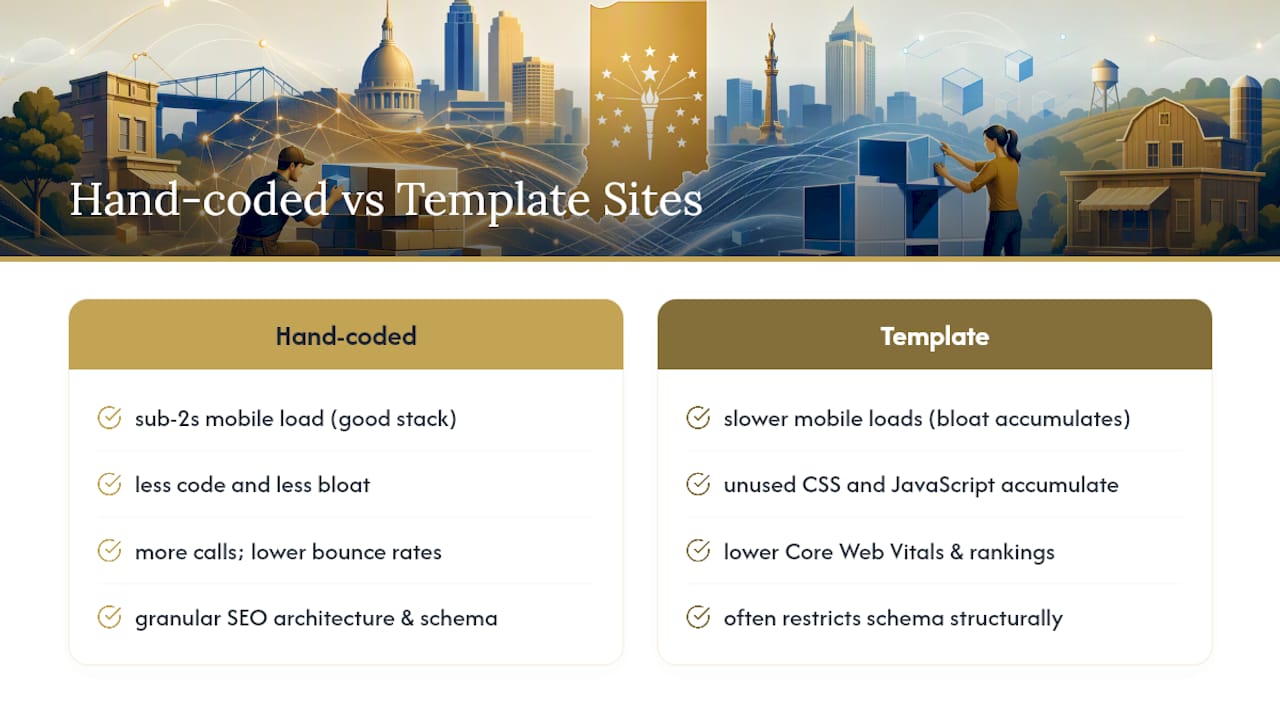
For a contractor in Terre Haute or a home-service business in Bloomington, a faster site means more calls from Google Maps, lower bounce rates, and more quote requests completed. A retailer in Washington, Indiana benefits from schema markup that surfaces reviews and hours directly in search results — something templates often restrict at the structural level. Custom builds let you implement SEO architecture and schema at a granular level, which is especially valuable in competitive local markets.
Ownership matters for the long term. A bespoke hand-coded website avoids recurring platform licence fees and gives you full control over code and content. If you ever change vendors, you take everything with you.
Managed plans typically remove 2–5 hours per month of owner time and include daily backups, security monitoring, and a named point of contact. For a business owner billing $75–$150 per hour for their own time, that math resolves quickly.
How does the build process work, and how long does it take?
Here is the typical sequence from first call to live site:
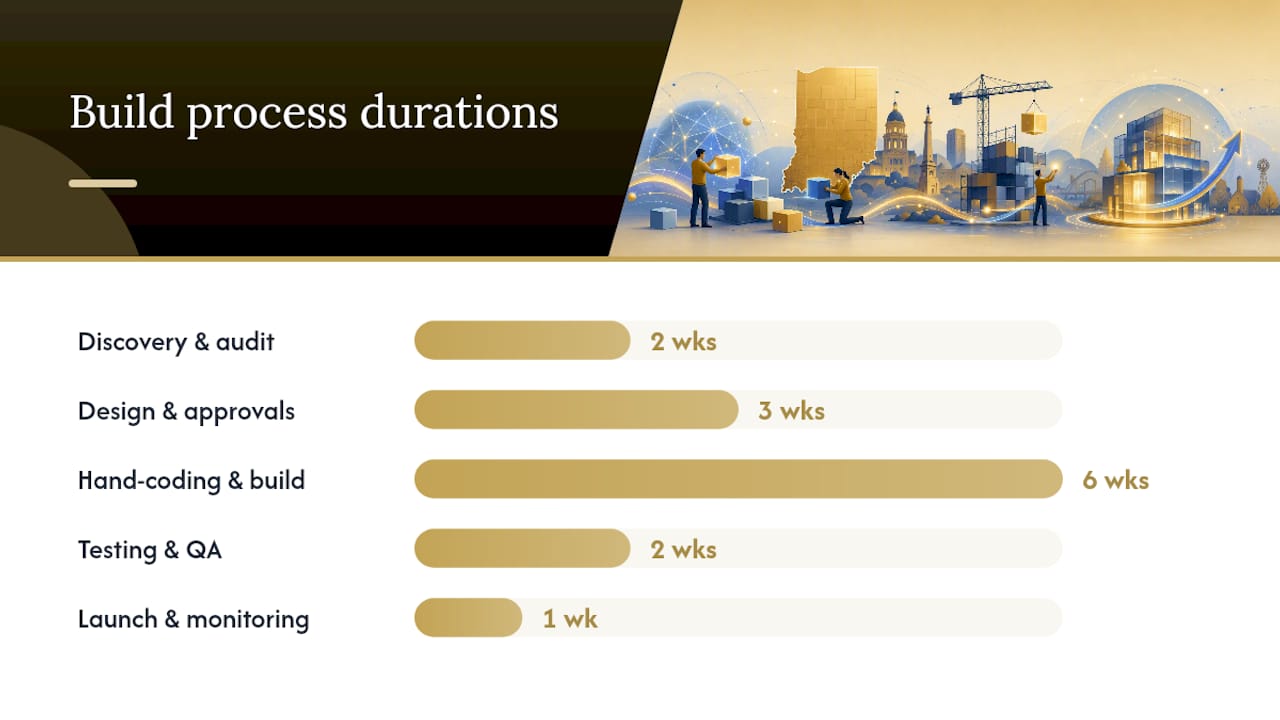
- Discovery and content audit (weeks 1–2): goals, audience, competitor review, content inventory, and branding assets collected
- Design and approvals (weeks 3–5): wireframes, visual design, and client sign-off
- Hand-coding and build (weeks 6–11): markup, styling, integrations, and CMS setup if needed
- Testing and QA (weeks 12–13): mobile testing, accessibility checks, performance audit, and cross-browser review
- Launch and monitoring (week 14): DNS cutover, Search Console verification, and 48-hour post-launch watch
- Transition to managed plan (day 1 post-launch): onboarding to monthly support, SLA confirmation, and first backup verified
Onboarding checklist — have these ready before discovery:
- Domain registrar login (GoDaddy, Namecheap, Cloudflare, or similar)
- Current hosting credentials if migrating
- Branding assets (logo files, brand colors, fonts)
- Key pages and content drafts or existing copy
- List of third-party integrations (booking tools, payment processors, CRM)
- Named decision-maker for approvals at each stage
The most common causes of delay are slow content approvals, missing branding assets, and scope changes after design sign-off. Keeping one decision-maker available for weekly check-ins cuts the typical timeline by one to two weeks.
The first 30–90 days on the managed plan include a post-launch performance review, any copy corrections, Core Web Vitals monitoring, and confirmation that backups are running and restoring cleanly.
Pro Tip: Insist that all plugin or third-party updates be tested on a staging environment with a documented rollback plan. Most site outages trace back to untested updates pushed directly to production.
What does website as a service pricing look like?
The model has two parts: a one-time build fee and a recurring monthly plan.
Monthly plan components typically include hosting, daily backups, security monitoring, SSL, uptime alerts, small content edits, and a support SLA. For businesses where the site directly drives revenue, a custom build can pay back its cost quickly through higher conversion rates and performance advantages over templated alternatives.
Budgeting tips:
- Add 10–15% of the build fee for paid third-party integrations (booking software, payment gateways, mapping APIs)
- Budget separately for content writing if you need professional copy
- Calculate three-year total cost: build fee plus monthly plan fees, then compare to a templated subscription that charges monthly forever with no ownership transfer
- Ask for a written scope of included edits in the monthly plan so you know what triggers a change order
Pro Tip: Review Kirk-co's pricing page before your discovery call. Knowing the ranges in advance makes the conversation faster and more productive.
What should you ask a vendor before signing?
Technical questions:
- Who owns the source code at launch, and will you provide Git repository access?
- Where are backups stored, and what is the documented restore SLA?
- Do you use a staging environment for updates before pushing to production?
- Can I get a code export and run the site independently if I leave?
Support and SLA questions:
- What is your guaranteed response time for urgent issues (site down)?
- What uptime percentage do you commit to in writing?
- How are security patches handled, and how quickly after a vulnerability is disclosed?
- Who is my named point of contact, and what happens if that person leaves?
Commercial and legal items:
- Cancellation terms: how much notice, and what happens to the site files?
- Renewal terms: are monthly rates locked or subject to annual increases?
- Scope of included edits: how many hours or changes per month before extra charges apply?
- Liability limits: what is the vendor's responsibility if the site goes down during a critical period?
Red flags to walk away from:
- Vendor will not put code ownership in writing
- Site runs on a proprietary CMS with no export path
- Backup policy is vague ("we back up regularly") with no stated frequency or restore SLA
- SLA windows are undefined or response times are "best effort" only
What do you actually own, and how does portability work?
Ownership in practice means holding four things: the source code, the domain, the content files, and database access. A vendor who controls any one of these controls your business's online presence.
Typical hosting access models:
- You own the hosting account; the vendor has delegated admin access
- The vendor owns the hosting account; you have read access and a contractual right to export
- Fully managed with a documented migration package available on request
Model one is the cleanest. Model two is acceptable if the contract specifies a migration package and timeline. Model three requires careful contract review.
Backup practices to confirm:
- Daily automated backups with off-site storage (not on the same server)
- Retention period of at least 30 days
- Documented restore SLA (how long to restore from backup on request)
- Quarterly restore tests performed and logged
Migration steps to request at contract signing:
- Exported source code archive (zip or Git repo)
- Database dump in a standard format (SQL or equivalent)
- Documented build environment (Node version, dependencies, deployment steps)
- DNS handover checklist with TTL guidance
- List of all third-party API keys and credentials held by the vendor
Pro Tip: Ask for a test export before you sign. A vendor confident in their process will provide one without hesitation. If they cannot, treat that as a portability risk.
Already have a site? Here's how to improve it safely
High-impact improvements for an existing Indiana business site:
- Compress and convert images to WebP format to cut page weight
- Replace heavy themes or page-builder plugins with leaner, hand-coded markup
- Fix or add schema markup for local business, services, and reviews
- Correct NAP (name, address, phone) consistency across the site and Google Business Profile
- Improve Core Web Vitals: Largest Contentful Paint, Cumulative Layout Shift, and Interaction to Next Paint
Safe migration checklist:
- Map every existing URL and build a 301 redirect plan before launch
- Verify Google Search Console ownership on the new site before DNS cutover
- Run a pre-launch crawl with a tool like Screaming Frog to catch broken links
- Stage sample pages and test on mobile before full cutover
- Monitor Search Console for crawl errors and ranking changes for 30 days post-launch
A thorough website audit before migration identifies which pages drive traffic and which redirects are critical, reducing the risk of ranking loss.
Pro Tip: Cut over DNS at a low-traffic time (Tuesday morning, not Friday afternoon) and keep the old hosting live for 48 hours as a fallback. Immediate 301 mapping preserves search equity from day one.
Kirk-co case study: a real Indiana business result
A Northwest Indiana trade association came to Kirk-co with a dated site that loaded slowly on mobile and generated almost no inbound leads. Kirk-co built a hand-coded site from scratch, implemented local schema markup, and set up a monthly website maintenance and support plan covering hosting, backups, and quarterly content updates.
Post-launch, the site achieved measurably faster mobile load times, improved Core Web Vitals scores, and a notable increase in contact form submissions within the first 90 days. You can review the full project on the Kirk-co portfolio.
What the project included:
- Full discovery, design, and hand-coded build
- Local SEO on-page setup and schema implementation
- Monthly managed plan: hosting, backups, security, and content edits
- Post-launch performance monitoring for 90 days
Pro Tip: Ask any vendor for a live portfolio link, not just screenshots. A live site lets you test load speed yourself using Google PageSpeed Insights.
When is this model right for you, and when is it not?
This model works best for Indiana local businesses where the website directly generates revenue: contractors, home-service providers, retailers, and nonprofits that rely on calls, form submissions, or foot traffic driven by search. If your site is your primary lead source, owning a fast, well-structured, hand-coded site with a predictable monthly support plan is the most cost-effective long-term structure. Custom-built websites remain a recommended option in 2026 for businesses that need control over SEO, URL structure, schema, and performance.
Best-fit scenarios:
- Local service business with repeat-value leads (HVAC, plumbing, roofing, legal, dental)
- Retailer or nonprofit needing a credible, fast-loading online presence
- Business owner who has outgrown a template site and is losing leads to slower load times
Where a smaller approach may be acceptable:
- A brand-new business testing demand with a minimal budget before committing to a full build
- A side project with no revenue dependency on the site
Transparent ownership and clear pricing are non-negotiable in any proposal worth signing. If a vendor cannot put both in writing, the risk is yours.
Kirk-co builds hand-coded Indiana websites you own
Kirk-co is the direct alternative to a rented template site for Indiana local businesses that need a fast, owned website and predictable monthly support. You get a hand-coded build, full code ownership, and a custom website development process designed around your business, not a generic template.
A free discovery call with Kirk-co includes a site audit of your current setup, a realistic timeline estimate, and a sample managed plan tailored to your business size. No obligation, no pressure.
- Site audit and performance review
- Timeline and scope estimate
- Sample monthly plan with pricing
View live Indiana projects or explore website maintenance plans. Ready to talk? Request your free discovery call and get a clear picture of what your site could do.
Sources
- Why Local Businesses Need a Bespoke Website (Not a Template) — LocalWebsCoder
- Why Small Businesses Should Invest in Fully Managed Websites